F equals ma will make your day - ChatGPT
General AdviceClassical mechanics is a field that every person in STEM has studied to a certain degree in their career. The reason is, if you think about it, it is the point when philosophical arguments started to be converted into concrete physical laws that could be expressed in the language of math. The idea of a “proof of concept” was set in stone during this period. It started a completely new era for humans as a race. Any course you will ever take as a physicist will assume this to be a prerequisite. This is why you always see physics coursework starting with this topic. There is no argument to escape it if you want to be a physicist..
📍 REFERENCE BOOKS
📖 Intro to CM : With Problems and Solutions - David Morin 🌟
Introductory Ideal for Beginners

As the title suggests, it’s an introductory book loaded with problems and solutions. For a first course and a solid start, I’d say dive into Chapters 1 to 5 and 7 to 9. Brace yourself because this book is packed with TONS and TONS of great problems, all neatly followed by solutions. Here’s my battle-tested strategy for tackling this gem:
- Read a section or chapter (depending on its size, of course).
- Go back and reread the examples until you’re confident you can solve them solo.
- If some steps still baffle you, chances are a particular concept needs a little more love. So, backtrack and reread those paragraphs or sections.
- Now, the real fun begins. Tackle 3-5 problems of various difficulties, and here’s the twist – no peeking at the solutions.
- Up the ante by taking on 2-3 medium-high difficulty problems. Sketch out a solution plan in your head and see if it aligns with the solution steps. In my humble opinion, Morin’s book is the full package for an introductory course in CM. It’s got it all – from the ABCs of free-body diagrams and circular motion to diving into the solutions of damped and driven oscillations. Plus, there’s a treasure trove of problems covering conservation laws and everything angular momentum-related. This book is a one-stop-shop. The only other lecture notes I’d suggest rocking in tandem would be David Tong’s notes (as always), and I’ve hooked you up with the link below. Happy reading and problem-solving!
📖 Classical Mechanics - David Tong 💫
Intermediate State-of-the-art

The reason I place this text at the intermediate level is simple: if you have never taken a formal course in classical mechanics, some of the concepts David Tong presents may not seem immediately obvious. (Though, if anyone can make them feel intuitive and inevitable, it is Tong.) The examples provided by Morin, on the other hand, build a nice foundation in classical mechanics. This material will expertly guide you to your next step as a physicist, regardless of the specialization you choose.
However, if your ambition is to be a Theoretical Physicist, then Tong’s work is a definitive must-read. It contains significantly more material than a single semester’s worth, easily covering a year-long course—a scope I believe holds true even for the rigorous curriculum at Cambridge, where these lecture notes originated and were later converted into a book.
📖 Classical Dynamics of Particles and Systems - Marion, Thornton
Intermediate
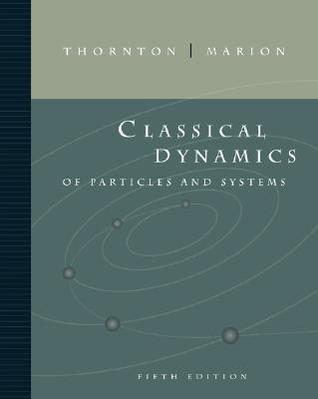
This book is a real gem. Unfortunately, I didn’t stumble upon it until a year or two into my bachelor’s. Eventually, I started using it as a reference whenever I needed to brush up on some topics. It’s still my go-to book whenever I need to recall certain concepts. I find the mathematical rigor in this book more sophisticated than in Morin’s. This can be super helpful when you need to quickly skim over topics you already know but might have forgotten some details. Sometimes, a glance at a mathematically precise equation or law can be more powerful than a whole paragraph explaining it (of course, only if you’ve already delved into the topic in detail).
Let’s say you’re tackling “Theoretical Physics I” (TPI) in Germany, which is all about Classical mechanics. I’d strongly recommend using this book alongside Morin because its mathematical rigor outshines Morin in certain areas (and TPI is all about that math rigor and a solid understanding of CM) - An alternative is to look into Tong’s book now.
Outside of Germany, it’s not a guarantee that your first CM course will cover Lagrangian and Hamiltonian mechanics (though it can happen). If it does, this is the book you want to crack open. The author covers the Calculus of Variations in the most gentle way possible – it’s a slow, steady, and highly effective approach. The whole book is fantastic, but the parts on Calculus of Variations, Lagrangian, and Hamiltonian mechanics are especially inspired (Again, Tong is also really good at it)
Oh, and the chapter on Special relativity? It’s concise and offers a ton of intuition. Trust me, this book is a game-changer. (And one last time, Tong does a brilliant job here too.. Sigh Tong is eating the Physics Textbook market)
📍 ADVANCED BOOKS
📖 Classical Mechanics - Goldstein
Advanced State-of-the-art
📖 Mechanics - Landau and Lifschitz
Advanced Old-is-gold